
For whom · Systems integrators & OEMs01 / 06

Integrate OT security. Keep the engineering boundary clear.

For systems integrators, machine builders and device manufacturers working on critical operational systems. Start with the installation: controls around existing assets, a defined cyber-safety response, or testing away from production.

Engineering questions02 / 06

Start with the installation.

A new machine, a retrofit or a control gap can expose the same problem: security measures must fit the process they protect.

Machinery placed on the EU market falls under the Machinery Directive 2006/42/EC. Machinery Regulation (EU) 2023/1230 applies from 20 January 2027 (EUR-Lex summary). The manufacturer or integrator remains responsible for conformity, and each deployment must be assessed for its own installation. aXite does not make safety certification promises.

01

Protect what must remain unchanged.

Add access and communication controls around existing controllers where replacement or code changes are not an option. Check protocol fit and the maintenance window before integration.

02

Define the response before the incident.

A network shutdown or power cut can create its own process risk. Define the required machine state, authorisation and recovery with the operator and safety-responsible parties.

03

Fit the implementation to the machine.

Check interfaces, runtime, latency and failure behaviour. Distinguish a supported deployment from an OEM or embedded variant that still needs development and validation.

04

Agree what acceptance must demonstrate.

Identify the scenarios, observations and responsibilities needed for commissioning and handover. Cybersecurity tests and safety acceptance answer different questions.

Integration principle03 / 06

The response has to fit the process.

Stopping communication is not the same as bringing a machine into an acceptable state. The engineering question includes what continues, what stops, who authorises the action and how the operator recovers.

Approaches04 / 06

Choose the approach the installation needs.

These are independent routes, not a mandatory sequence.

Pillar 2 · Control Safety

AX-Interlock

Connect cyber detection to a designed intervention.

For critical industrial machines where a validated cyber event needs a process-specific response. AX-Interlock combines aXite security software with a safety-controlled intervention path, designed with the operator and engineering partners.

The integration is lab-tested. Operational validation and certification scope remain open. aXite security software is required; AX-Box Gatekeeper hardware is not a prerequisite.

Deployment on partner hardware is an intended delivery route; agreements and integration responsibilities still need to be established.

Explore AX-Interlock →
Pillar 1 · Protect

Add controls around operational assets.

Critical industrial installations

AX-Box Gatekeeper mediates access and communication around supported legacy PLCs without an agent or PLC-code change. Installation, policy configuration and acceptance take place within the agreed maintenance scope.

Protect for critical industry →

Meter and device integration

For OEMs working with network operators, AX-Energy Protect adds local detection and policy enforcement at energy grid endpoints. The appliance is available; embedded variants and lifecycle management for mass rollout still need completion and validation.

Protect for energy →

Pillar 3 · Resilience

AX-Cyberrange

Investigate the scenario away from production.

Explore whether an isolated representative copy can help investigate attack paths, process effects and changes before field deployment. For an integrator or OEM project, supported systems, available specifications and model fidelity determine whether a scoped test environment is feasible.

Tests run in the copy, not on the live installation. No AX-Box Gatekeeper or Interlock purchase is required.

Explore AX-Cyberrange →
Scope and evidence05 / 06

Agree what the installation must demonstrate.

Architecture

Interfaces, controller or runtime, data paths and behaviour when communication or components fail.

Validation

Process-specific response, test scenarios, observations and acceptance criteria.

Handover

Configuration ownership, updates, maintenance, recovery and support responsibilities.

Agree these with the operator and relevant engineering and safety parties. A product's track record does not replace installation-specific acceptance. Documented architecture, validation and handover evidence helps you demonstrate how the installation was assessed. It does not guarantee compliance and does not make the system certified.

Explore aXite's wider track record →
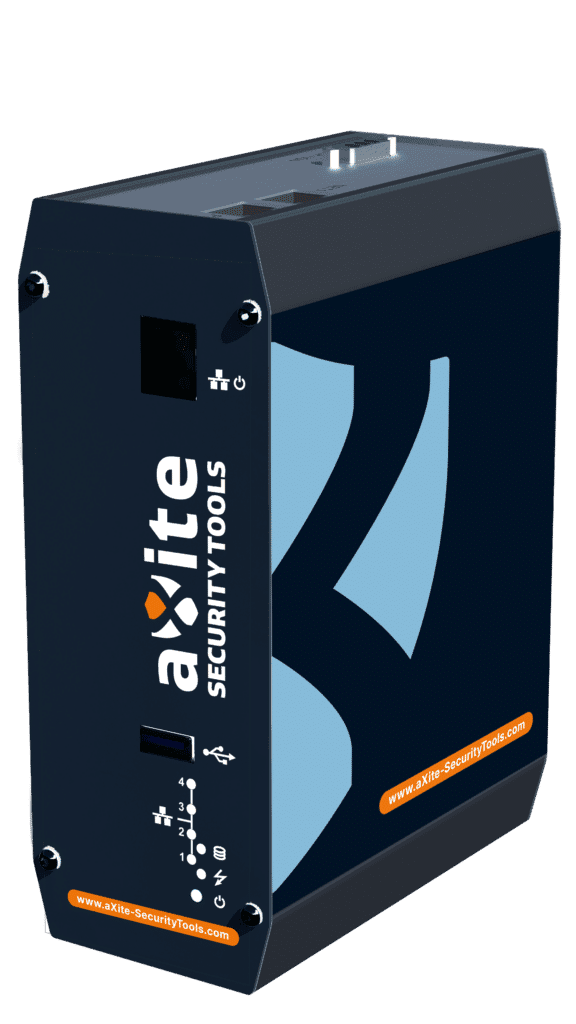
AX-Box Gatekeeper hardware appliance.
Control-cabinet. Product photo of the AX-Box Gatekeeper appliance; it does not show a device installed in a customer cabinet.
Next step06 / 06

Start with the installation you are engineering.

Bring the installation context, controllers and interfaces, and the security or response question. We can identify the relevant approach and the engineering work needed for your project.

Discuss an integration →